Vajrapāṇi Explained: The Thunderbolt-Bearer and Guardian of the Rooster
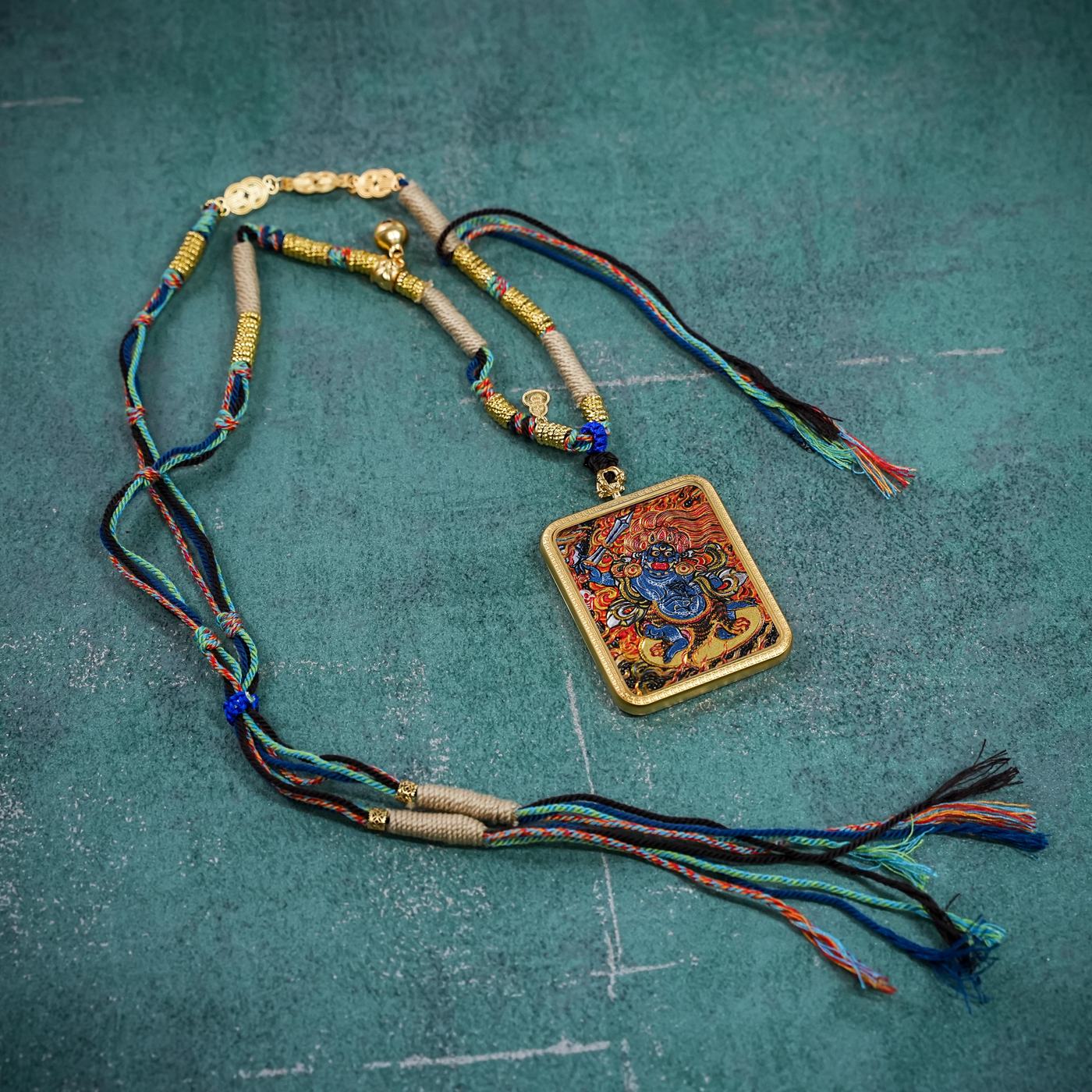
Among the eight guardians, Vajrapāṇi is the one most likely to catch a newcomer off guard — flames, bulging eyes, a raised weapon — before the actual meaning behind the fierce imagery has a chance to land.
Who is Vajrapāṇi?
Vajrapāṇi's name means, quite literally, "vajra in hand." He is one of the earliest protector figures in Buddhist art, appearing already in some of the oldest surviving Buddhist sculpture as a guardian standing beside the historical Buddha himself. In the Eight Guardian Buddha tradition covered in our zodiac guardian guide, he watches over those born in a Rooster year — a sign traditionally associated with vigilance, honesty and plain speaking, qualities that align naturally with a guardian whose entire role is protection through unflinching clarity.
In Tibetan Buddhism specifically, Vajrapāṇi is one of the three central protector figures known as Rigsum Gönpo, the "Lords of the Three Families" — alongside Avalokiteśvara (compassion, covered in our Guanyin guide) and Mañjuśrī (wisdom, covered in our dedicated guide). Together the three represent compassion, wisdom and power as a complete set, and images of all three grouped together are extremely common across Tibetan temples, thangka and household shrines specifically because the grouping is considered so foundational.
What the vajra actually represents
The vajra — the ridged, thunderbolt-shaped object Vajrapāṇi holds — is one of the most important ritual symbols in Vajrayana Buddhism (the school's very name derives from it). It represents a quality that is at once indestructible and diamond-clear: a state of realization so solid that confusion cannot crack it, and so sharp that it cuts through illusion the instant it makes contact. Holding the vajra is not a claim to violence; it is a claim to unshakeable clarity.
This is a detail worth remembering, since Vajrapāṇi's fierce appearance is easy to misread as aggression when it is, within the tradition, closer to the opposite: a form so committed to protecting the truth that nothing can intimidate it into backing down.
The vajra and bell in actual practice
Beyond thangka imagery, the vajra is also a physical ritual object used in Vajrayana ceremony, almost always paired with a bell held in the other hand. The vajra represents skilful method and the bell represents wisdom; holding both together, one in each hand, is meant to embody the union of the two as inseparable rather than sequential steps. Seeing Vajrapāṇi depicted holding the vajra alone, rather than the paired vajra-and-bell set used in ritual, reflects his specific role as embodiment of that indestructible quality on its own, standing guard rather than conducting a ceremony.
Why a fierce, wrathful form
Wrathful deities are a distinct and well-established category across Tibetan Buddhist art, existing alongside serene, peaceful forms like Avalokiteśvara or Tārā. The fierce appearance is understood as compassion wearing the face it needs to wear for the job at hand: gentleness persuades, but some obstacles — deep-seated ignorance, real danger, entrenched harm — respond better to something that will not be talked out of protecting what matters. Vajrapāṇi is traditionally counted among the guardians of the Buddhist teachings themselves, tasked with making sure they survive intact rather than being diluted or lost.
The Rooster year, and beyond it
Beyond the birth-year pairing, Vajrapāṇi is a common choice for anyone who wants a reminder to hold their ground — in a difficult negotiation, a period of external pressure, or simply a season of life that calls for backbone rather than accommodation. He is also chosen by people drawn to the wrathful-deity aesthetic itself, independent of the zodiac pairing.
Common questions
Is Vajrapāṇi an angry or violent figure?
Within the tradition, no — his fierce appearance represents protective, uncompromising clarity rather than anger directed at any being. This is a common point of confusion for newcomers encountering wrathful deities for the first time.
What is Rigsum Gönpo?
It refers to the grouping of Vajrapāṇi, Avalokiteśvara and Mañjuśrī as the "Lords of the Three Families," representing power, compassion and wisdom together as a complete foundational set within Tibetan Buddhist practice.
Why is the vajra usually paired with a bell in ritual, but not in Vajrapāṇi's imagery?
The paired vajra-and-bell set is used to represent method and wisdom in active ceremonial use. Vajrapāṇi holding the vajra alone reflects his specific identity as the embodiment of that quality standing guard, rather than a depiction of ritual practice itself.
Is he related to Vajrasattva?
They share the "vajra" root in their names and some symbolic territory, but are distinct figures with different roles — Vajrasattva is primarily associated with purification practice, while Vajrapāṇi's defining role is protection.
Can I wear Vajrapāṇi if I wasn't born in a Rooster year?
Yes — as covered in our guide to choosing a guardian, selecting by the quality you want to cultivate, in this case resolve and clarity under pressure, is a widely accepted approach alongside the birth-year tradition.