Samantabhadra Explained: The Bodhisattva of Universal Action
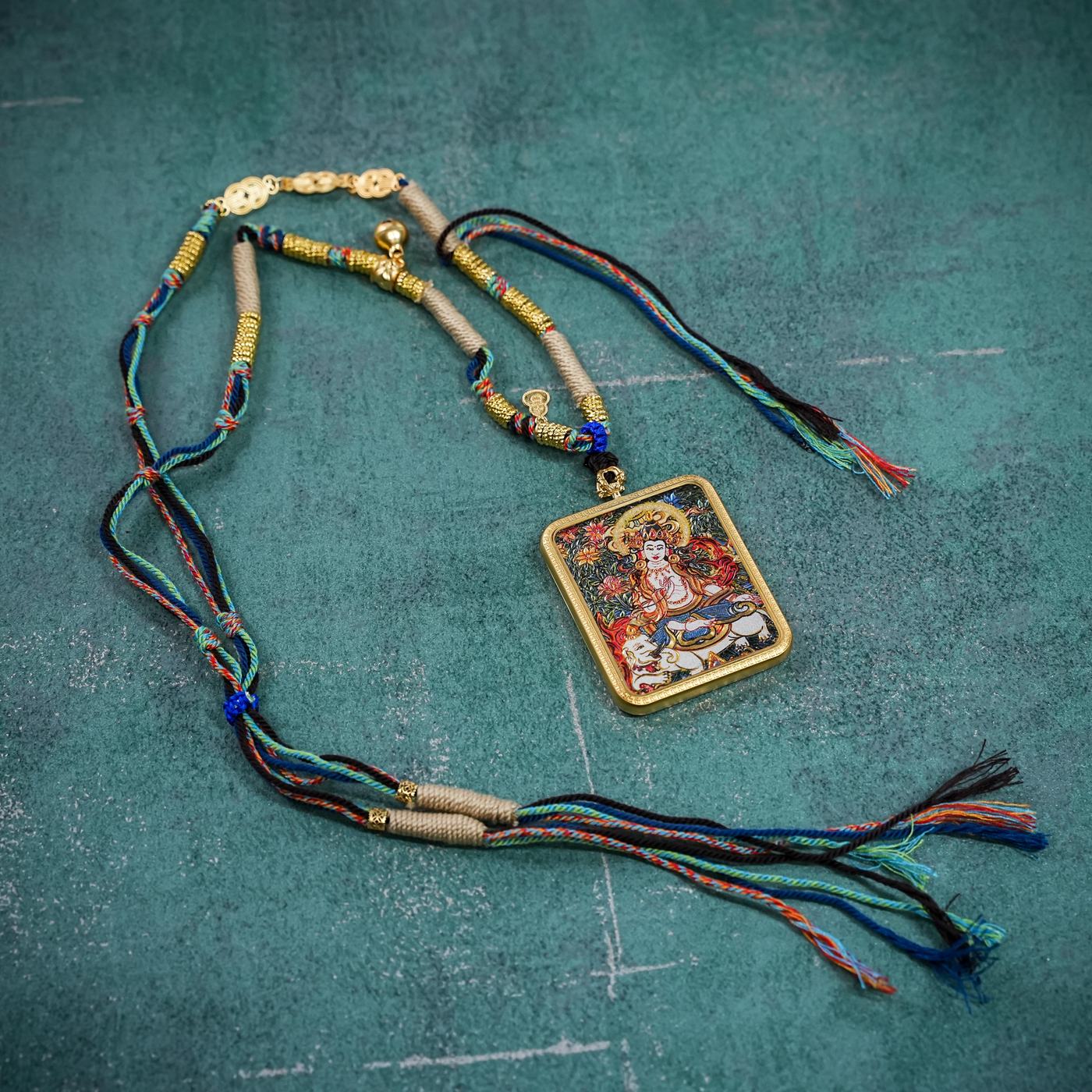
Wisdom that stays as an idea, never acted on, is only half of the path in Mahayana Buddhism. Samantabhadra is the bodhisattva who represents the other half — the part where understanding actually moves through hands and days and decisions.
Who is Samantabhadra?
Samantabhadra's name is generally translated as "universally worthy" or "all-good," pointing to a completeness that shows up in conduct rather than in doctrine alone. In the Eight Guardian Buddha tradition covered in our zodiac guardian guide, he watches over people born in the years of the Dragon and the Snake — two signs traditionally associated with ambition and depth, qualities that benefit from exactly the kind of steady, principled follow-through this bodhisattva represents. He appears prominently in the Avatamsaka (Flower Garland) Sutra, one of the longest and most detailed texts in the Mahayana canon, where his vows form a central closing teaching.
Why a six-tusked white elephant
Samantabhadra is almost always shown seated on a white elephant with six tusks, and the detail is worth unpacking rather than skimming past. An elephant, in South and East Asian symbolism generally, represents tremendous strength and steadiness — an animal capable of enormous power that is, when trained, entirely calm and controllable. The white colour signals purity of intention behind that strength. The six tusks are traditionally read as representing the six pāramitās (perfections) cultivated on the bodhisattva path: generosity, ethical conduct, patience, diligence, meditative concentration and wisdom. Put together, the mount is a compact visual argument: real spiritual power looks like great capability held in complete, purposeful discipline — not restraint through weakness, but restraint through mastery.
The ten great vows
Samantabhadra's section of the Avatamsaka Sutra is often referred to simply as "the ten great vows," a set of aspirations that has been recited and studied independently of the larger text for centuries. In broad terms, they include vowing to pay respect to all Buddhas, to praise their qualities, to make offerings, to repent past wrongdoing, to rejoice in the merits of others, to request teachings, to ask teachers to remain in the world, to keep learning from the Buddhas, to constantly accord with the needs of all beings, and to dedicate all merit generated to the benefit of others rather than keeping it for oneself. Read together, the vows describe a very specific shape of practice: outward-facing, relentlessly generous, and more concerned with sustained conduct than with any single dramatic gesture.
Wisdom decides what matters. Samantabhadra is what happens after that decision is made.
Paired with Mañjuśrī: wisdom and action
Samantabhadra is very frequently depicted alongside Mañjuśrī — the bodhisattva of wisdom covered in our dedicated guide — flanking a central Buddha figure, one on a lion, the other on an elephant. The pairing is intentional rather than decorative: Mañjuśrī represents the clarity to see what is true, and Samantabhadra represents the follow-through to actually live it out. Traditional teaching treats the two as inseparable in a mature practice — wisdom without action stays theoretical, and action without wisdom risks going nowhere useful. Wearing or choosing between the two often comes down to which half of that pairing feels more like the current work: clarifying a decision, or actually carrying one out.
Mount Emei: his sacred mountain
Continuing a pattern found across several guardians in this collection — Avalokiteśvara's Potalaka, covered in our Guanyin guide, and Mañjuśrī's Mount Wutai, covered in our dedicated guide — Samantabhadra is traditionally associated with Mount Emei in Sichuan, China, one of the four sacred mountains of Chinese Buddhism. Pilgrims have travelled to Emei for over a thousand years specifically to seek his blessing for the qualities he represents: sustained, principled action. A large bronze statue of Samantabhadra on his elephant stands at the mountain's Wannian Temple, among the oldest surviving bronze Buddhist sculptures in China, underscoring just how long this specific association has held.
Who tends to wear him
Beyond those born in Dragon and Snake years, Samantabhadra is a common choice for anyone in the middle of turning a decision into sustained follow-through — starting a long project, keeping a commitment through a difficult stretch, or simply wanting a daily reminder that good intentions need consistent, unglamorous action behind them to matter.
Common questions
Is Samantabhadra the same in Chinese and Tibetan traditions?
The core identity and vows are shared across Mahayana and Vajrayana Buddhism generally, though artistic style and specific emphasis can vary by region — Tibetan thangka traditions, including ours, tend to render him within the same visual conventions used for the other guardian figures in this collection.
Is Mount Emei still an active pilgrimage site?
Yes — Emei remains an active Buddhist pilgrimage destination and UNESCO World Heritage site, with numerous temples and monasteries dedicated to Samantabhadra still in regular use today.
Why do Mañjuśrī, Samantabhadra and Avalokiteśvara each have a sacred mountain?
The pattern reflects a broader tradition in Chinese Buddhism of associating major bodhisattvas with specific sacred sites, giving devotees a physical place of pilgrimage tied to each figure's particular qualities — wisdom, action and compassion respectively.
Why an elephant instead of a more common mount like a lion?
The elephant's specific symbolism — strength paired with trainable calm — fits Samantabhadra's theme of power channelled into steady action more precisely than a lion would, which is why the pairing has remained fixed across centuries of thangka and sculpture.
Do I need to know the ten vows to wear this pendant meaningfully?
No — as with the other guardians, understanding the broad idea (wisdom put into consistent, generous action) is enough for most wearers. The vows are there to explore further if you want to, not a prerequisite.