Green Tārā: Swift Protection and Compassionate Action
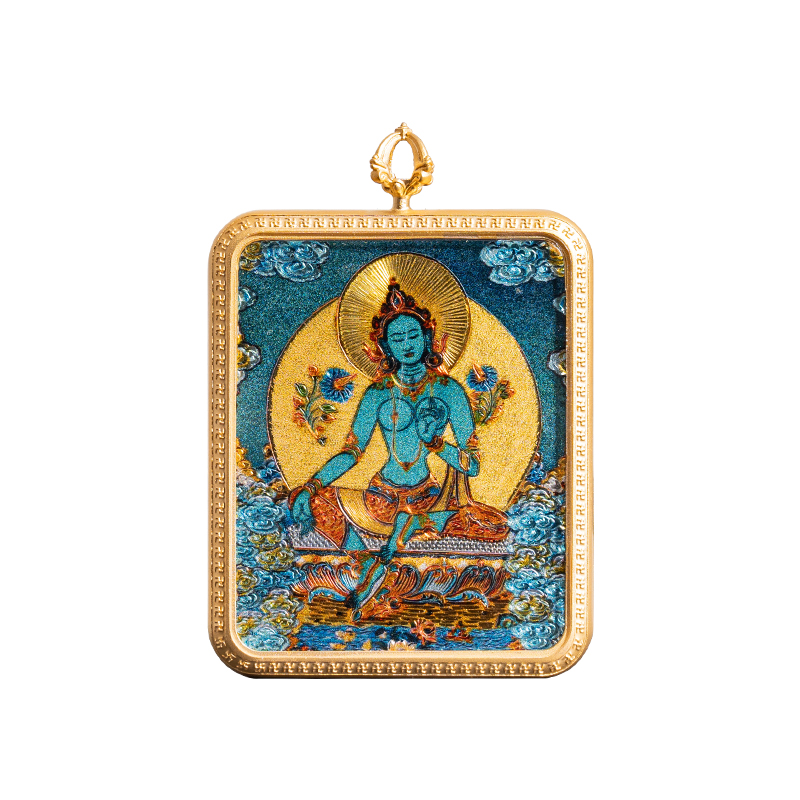
Among all Himalayan Buddhist deities, Tārā is one of the most beloved precisely because of how she is described: not distant or difficult to reach, but quick to respond the moment she is called on.
Where Tārā comes from
Tārā's name is generally understood to mean "she who saves" or "star," and she appears in Tibetan Buddhism in twenty-one traditional forms, of which Green Tārā and White Tārā are the two most widely venerated. According to one well-known account, Tārā arose from the tears of Avalokiteśvara — the bodhisattva of compassion covered in our dedicated guide — moved by the suffering he witnessed in the world and unable to help everyone through his own form alone. In this telling, Tārā represents compassion given a second, faster way to act.
A separate and equally well-known origin story centres on a princess named Yeshe Dawa, who is said to have generated such deep compassion that she resolved to attain full enlightenment. When advised by monks that she should pray to be reborn as a man to progress further on the path — a common assumption in the surrounding culture at the time — she is said to have firmly refused, vowing to keep taking female rebirth again and again until she reached complete Buddhahood, specifically to demonstrate that gender is no barrier to enlightenment. Tārā is regarded as the fulfilment of that vow, which is part of why she holds particular significance as a principal female Buddha in her own right, rather than a secondary or supporting figure.
Why green, and why one foot forward
Green in Tibetan Buddhist iconography is associated with the "action" or "accomplishing" wisdom — the quality of compassion that moves rather than simply feels. This is reinforced visually: unlike many seated deities shown in full lotus posture, Green Tārā is traditionally depicted with her right leg extended, foot resting on a lotus, as though she is already rising to help rather than waiting to be asked twice.
Her left hand is typically shown in the gesture of granting refuge, and her right in the gesture of generosity — together forming a fairly literal visual promise: protection offered, and help given.
The eight fears
Traditional prayers to Tārā often reference protection from "the eight great fears" — commonly listed as lions (pride), wild elephants (delusion), fire (anger), snakes (jealousy), robbers (wrong views), imprisonment (greed), floods (attachment) and demons or evil spirits (doubt). Read literally these appear to be physical dangers; read as they are traditionally taught, each pairs a worldly danger with an inner emotional state that produces similar harm, which is part of why the prayers have remained meaningful well beyond any one historical period. Historically, this list is far from abstract — merchants and travellers on the trade routes through the Himalayas genuinely faced wild animals, bandits, floods and fire on their journeys, and recitations to Tārā for protection before a journey were, and in many communities still are, a standard practice rather than a purely symbolic one.
Tārā and Tibetan royal history
Tārā's presence in Tibet is tied to one of the country's most well-known legendary histories. The seventh-century king Songtsen Gampo, credited with helping establish Buddhism in Tibet, is traditionally said to have taken two wives of great religious significance: a Nepalese princess, Bhrikuti, and a Chinese princess, Wencheng — each of whom is regarded in popular tradition as an emanation of Tārā, one green and one white. Whatever the precise historical fact behind the legend, the story cemented Tārā's association with Tibet's own royal and religious founding narrative, which is one reason her worship remains so deeply woven into Tibetan Buddhist culture specifically, beyond her broader popularity across the wider Buddhist world.
Who tends to wear her
Green Tārā is frequently chosen during genuinely difficult passages — illness, travel, uncertainty, a hard transition — rather than as an everyday piece chosen for aesthetics alone, though many wearers do keep her as a long-term companion once the association feels personal. She is also a common gift for someone going through a hard time, since her symbolism of swift, active compassion translates clearly without requiring deep prior knowledge of Buddhist iconography.
Common questions
Is Green Tārā connected to a specific zodiac year?
No — like the other protector figures in this collection, she sits outside the twelve-year zodiac guardian system and is chosen by intention or personal resonance rather than birth year.
What is the difference between Green Tārā and White Tārā?
White Tārā is traditionally associated with long life, healing and calm, often shown fully seated in meditation, while Green Tārā is associated with swift, active protection and is shown ready to move. Many collections, including ours, currently focus on the Green form as the most widely requested.
Can I wear Green Tārā alongside my zodiac guardian?
Yes — there is no rule limiting wearers to a single pendant, and pairing a birth-year guardian with a protector figure chosen for a specific season of life is a common, accepted practice.
Is Tārā considered a Buddha or a bodhisattva?
Both descriptions appear across different textual traditions — some sources describe her as a bodhisattva of compassion in action, others as a fully realised female Buddha in her own right, reflecting her particular status as a principal, independent figure rather than a minor deity.
Why are there twenty-one forms of Tārā?
A well-known devotional text, the Praises to the Twenty-One Tārās, describes twenty-one distinct aspects of her activity, each associated with a particular colour, quality and protective function. Green and White remain the most widely practised and depicted of the twenty-one today.
Is the story of Yeshe Dawa historically documented, or legendary?
It belongs to traditional hagiography rather than verifiable history — its significance lies in the teaching it carries about determination and gender, not in being a historical record in the modern sense.