Yellow Jambhala Explained: The Buddha of Wealth and Generosity
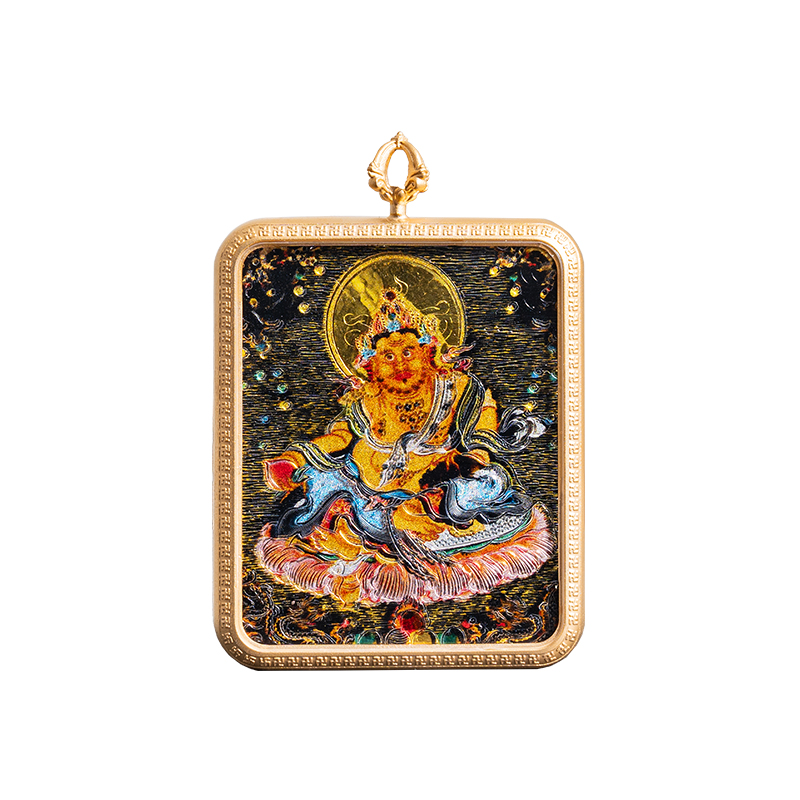
Of the eight protector figures in the wider guardian tradition, Yellow Jambhala is the one most directly associated with money — which makes him both one of the most requested pendants and one of the most commonly misunderstood.
Who is Yellow Jambhala?
Jambhala (also known by the Sanskrit name Vaiśravaṇa/Kubera in some traditions) is a wealth deity found across Tibetan, Nepalese and wider Himalayan Buddhist practice, existing in several colour forms — yellow, white, black, red and green — each associated with a slightly different aspect of prosperity. Yellow Jambhala is the most widely depicted form and the one most closely tied to general wealth and abundance rather than a narrower specialty.
His origin traces back further than Buddhism itself: Kubera was already established as a wealth deity and guardian of the north in earlier Vedic and Hindu tradition before being adopted into the Buddhist pantheon as a Dharmapala — a protector specifically tasked with supporting practitioners' material needs so they are free to pursue practice without the constant pressure of poverty. This lineage matters because it explains why Jambhala's role has always been practical and this-worldly, rather than purely symbolic — he was, from the start, a figure people turned to for genuinely tangible support.
He is typically shown seated, holding a citron fruit (a symbol of longevity and prosperity) in one hand and a mongoose spewing jewels in the other — an image worth understanding properly, since it is often reduced to "the money mongoose" without context.
Reading the iconography
The mongoose is the detail most people ask about. In the traditional telling, the mongoose is said to be able to identify and disgorge jewels, but only ones that have been rightfully or virtuously obtained — a built-in reminder that the wealth Jambhala grants is tied to how it is used and gathered, not wealth without condition. The citron fruit reinforces a related idea: nourishment and prosperity that ripens naturally rather than being seized.
His yellow-gold colouring itself is traditionally associated with the earth element in Buddhist iconography, connecting him to grounded, tangible abundance rather than abstract fortune. His seated, slightly rounded posture — often mistaken by newcomers for the unrelated "Laughing Buddha" figure common in secular good-luck decor — is meant to convey ease and contentment rather than the striving, anxious energy often associated with the pursuit of money.
The wider family: Jambhala's other forms
Tradition recognises several colour forms of Jambhala beyond the yellow one, each carrying a slightly different emphasis: White Jambhala is associated with purification and removing obstacles tied to wealth (debt, financial confusion), Black Jambhala with rapid, more forceful removal of poverty-related hardship, Red Jambhala with magnetising resources and opportunity, and Green Jambhala with wealth connected to activity and business dealings specifically. Yellow remains the most commonly practised and requested form precisely because it is considered the most general and broadly applicable — the "default" wealth practice most teachers introduce first, which is why it is the form selenecc offers.
Wealth as a practice, not a shortcut
It is worth being direct about something often left vague in casual descriptions: Yellow Jambhala is not traditionally understood as a guarantee of sudden riches, and treating the pendant that way misses the point of the practice associated with him. In most Tibetan Buddhist teaching, devotion to Jambhala is paired explicitly with generosity — the idea that a mindset of scarcity and hoarding blocks abundance, while a practice of giving, fair dealing and gratitude creates the conditions where prosperity can actually take root and be sustained.
In that sense, wearing the pendant functions less like a lottery ticket and more like a daily nudge toward the financial habits — patience, fairness, generosity — that tend to produce durable results over time.
Not to be confused with the "Laughing Buddha"
Because both figures are rounded, seated and associated with good fortune, Yellow Jambhala is frequently confused with Budai (Hotei), the "Laughing Buddha" of Chinese folk tradition and popular good-luck ornaments. They are unrelated: Budai is a semi-legendary wandering monk figure from Chinese folklore, adopted into popular culture as a symbol of contentment and luck, while Jambhala is a specific Buddhist protector deity with a defined iconography, textual history and practice lineage. Knowing the difference is useful mainly so the pendant is understood for what it actually represents, rather than folded into a more generic "lucky charm" category it doesn't quite belong to.
Who tends to wear him
Because the association is with prosperity broadly rather than one birth year specifically, Yellow Jambhala is commonly chosen ahead of a new job, a business launch, a house purchase, or simply as a New Year piece regardless of zodiac sign. He is also a frequent choice as a gift for someone starting a new venture, since the symbolism translates clearly without needing an explanation of the zodiac guardian system first.
Common questions
Is Yellow Jambhala the same as Green Tārā?
No — they are entirely different figures with different associations. Green Tārā is a female bodhisattva connected to swift compassionate protection, covered in our dedicated guide, while Jambhala is specifically a wealth deity. Some wearers choose both for complementary reasons.
Is this one of the twelve zodiac guardians?
No — Yellow Jambhala sits outside the birth-year guardian system entirely; he belongs to a separate group of protector and wealth deities that wearers choose by intention rather than zodiac sign.
Is it inappropriate to want a "money Buddha"?
Not at all — financial security and the ability to provide for family are considered entirely legitimate concerns within Buddhist lay practice. The tradition simply frames the wish alongside the ethics of how wealth is gathered and used.
Is Jambhala the same figure as Kubera?
They share the same root — Kubera is the earlier Vedic/Hindu wealth deity that Buddhism absorbed and reframed as the protector Jambhala — so the two names point to closely related, historically connected figures rather than entirely separate ones.
Why is Yellow Jambhala the most common form to see?
Yellow is generally taught as the foundational, most broadly applicable form of the practice, which is why it appears most often in pendants, statues and thangka compared to the other colour variations.
Can I wear Yellow Jambhala without any Buddhist background?
Yes — as with the other protector figures in this collection, wearing the pendant as a meaningful daily reminder of the values it represents (fair dealing, generosity, patience) does not require prior practice or formal study.